

When companies talk about protecting sensitive data, the conversation usually starts in the same place 👀 Dynamics, SAP, Salesforce, SharePoint, the HR system, the finance platform.
Where is the sensitive data stored?
Which system is the most critical?
Which application needs the strongest controls?
Those are reasonable questions.
They are just often not the most useful ones.
Because in many real incidents, the breach does not happen where the data lives.
It happens where the data starts moving 💥
- A file gets downloaded 📥
- A record gets exported 📊
- A report lands on the laptop 💻
- An attachment leaves via email 📧
- A browser upload sends it somewhere else 🌐
- A USB stick turns internal data into portable data 💾
And suddenly, the most important system is no longer the one that stores the information.
It is the one that lets it leave 🚪
The question is no longer only where data is stored. The more important question is where data actually leaves control.
The question is not only where data is stored
That is the real shift 🔄
Most organizations still think about data protection in terms of source systems 📦 which application contains the sensitive information, which repository needs tighter access, which platform needs more monitoring.
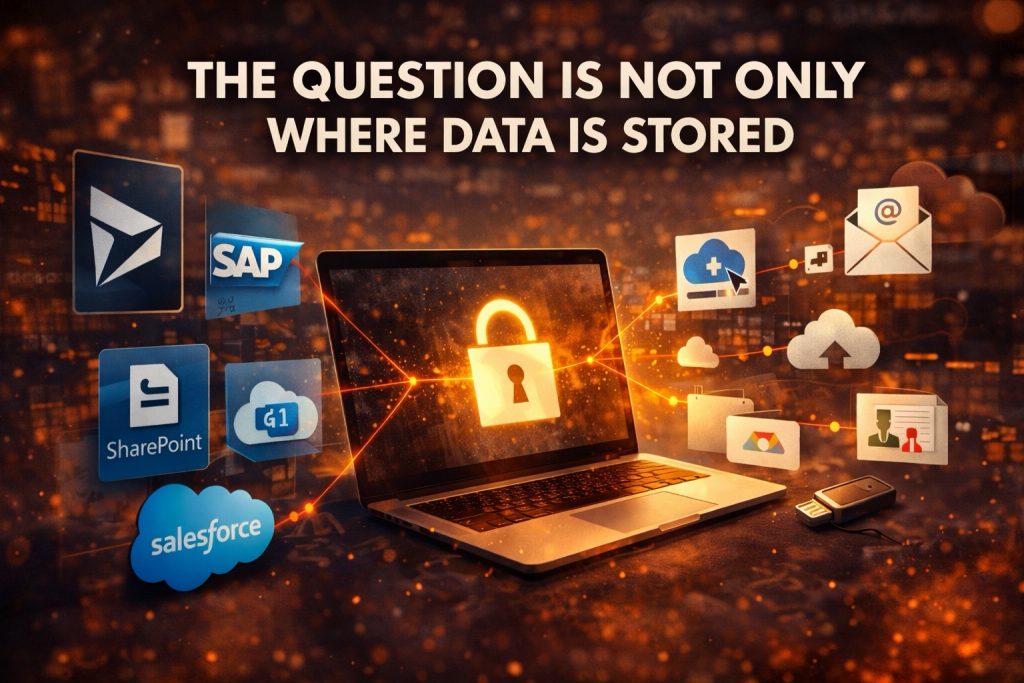
But that only tells part of the story.
The more important question is often much simpler:
Where does the organization actually lose control?
And in many real world cases, the answer is not Dynamics.
Not SAP.
Not Salesforce.
Not even SharePoint.
It is the endpoint 💻
The source system stores the data. The endpoint makes it portable.
That is where things begin to change.
Inside a business application, data still lives in a governed environment 🔐 permissions exist, audit trails exist, workflows exist, and access can be controlled in a relatively structured way.
But once the data leaves that environment, the whole risk profile changes.
- A report becomes a local file 📄
- A customer record becomes an email attachment 📎
- A case export becomes a spreadsheet in Downloads 📂
- A sensitive document becomes a browser upload ☁️
- A table becomes copy and paste into another tool 📋
That is the moment when business data stops being application-bound and starts becoming portable.
And portable data is much easier to lose ⚠️
That is why the laptop matters so much
This is the uncomfortable part.
In many organizations, the laptop is not seen as the most critical system. It is treated more like a work surface 💻 a place people use to access the real systems.
But in practice, it is often the point where a breach becomes real.
Not because the laptop originally contained the data.
But because it becomes the place where data can be moved, copied, attached, uploaded, synced, printed, or taken elsewhere 🔁
That is why the endpoint matters so much. It is where protected business data often turns into transferable data.
And once that happens, the source system may no longer be the decisive control point.
A secure business application can still feed an insecure path outward
That is the trap 🪤
A system can be properly secured and still become part of a breach story.
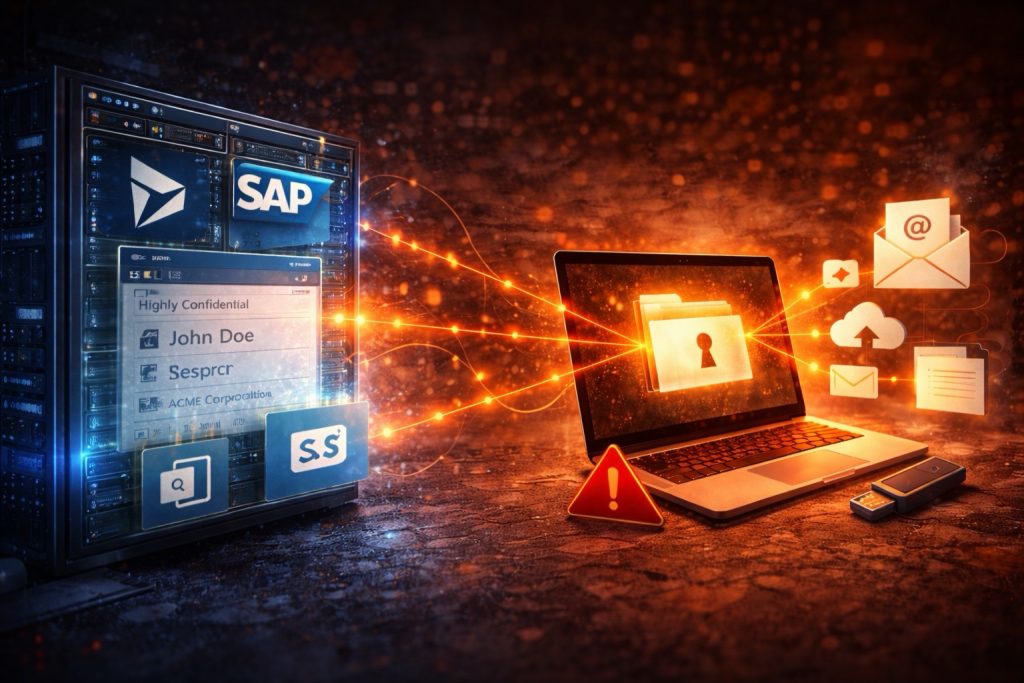
Take a simple example.
- An employee accesses sensitive information in Dynamics 🧩
- The permissions are correct ✅
- The system is well governed 🏛️
- The access itself is legitimate 👤
Nothing has gone wrong yet.
But then the user exports the data. The file lands locally. From there, it is emailed externally 📧 uploaded into a personal cloud service ☁️ copied into another tool 📋 or moved to a USB device 💾
At that point, asking whether Dynamics was secure is no longer enough.
What controlled the data after it left Dynamics?
That is where many security strategies still have a blind spot 👓 they focus heavily on where data lives, but not enough on what happens once that data starts to travel.
The real outbound channels are surprisingly ordinary
This is also why so many breaches feel unspectacular at first.
The outbound paths are usually not exotic. They are the tools people use every day 🧰
- Email 📧
- Browser uploads 🌐
- USB devices 💾
- Copy and paste 📋
- Personal cloud storage ☁️
- External sharing 🔗
- Printing 🖨️
- External AI tools 🤖
That is what makes the problem so persistent.
Sensitive data from ten completely different business systems can all leave the company through the same handful of channels. From a protection perspective, that matters more than many organizations admit.
Because once the data has been downloaded, attached, shared, or pasted somewhere else, it no longer matters much that it originally came from a well governed source system.
The loss happens at the point of movement 🚚
This is where Endpoint DLP becomes so important
This is exactly the point where Microsoft Purview Endpoint DLP changes the conversation.
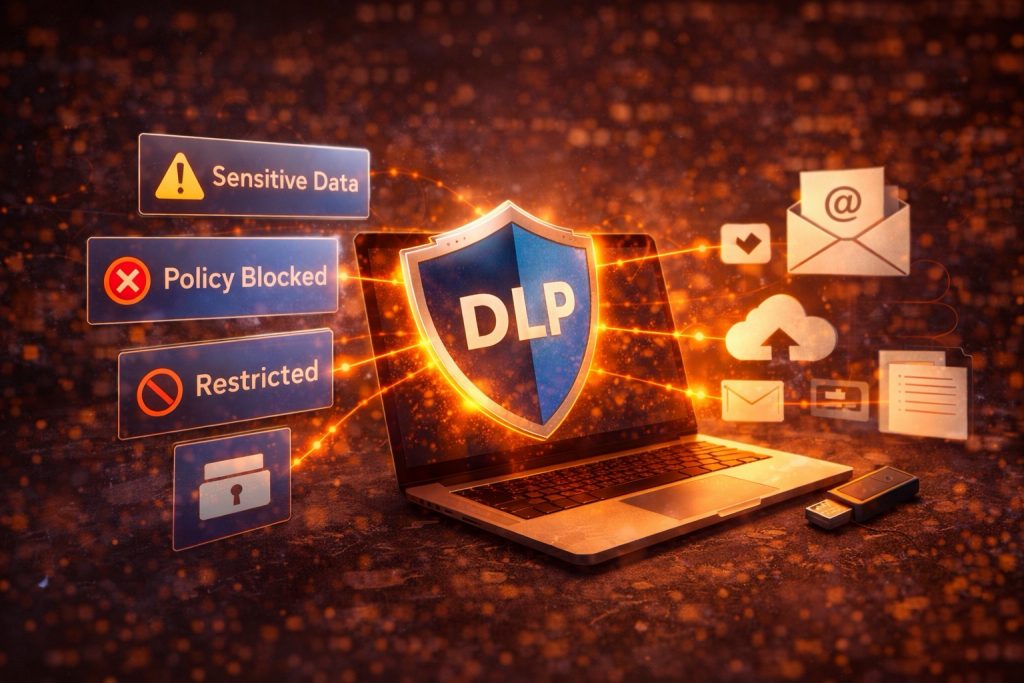
Without endpoint controls, a lot of security strategy stays stuck at the source system 🧱 you know where the data lives, you may even know who accessed it, but once it has been downloaded to the device, many organizations suddenly lose visibility.
That is the real significance of Endpoint DLP 🧭 it extends protection into the place where data becomes portable.
In the Purview context, that matters enormously because modern data loss is often not about a dramatic intrusion into one system. It is about sensitive data moving across everyday user actions:
- a download 📥
- an attachment 📎
- a browser upload 🌐
- a copy action 📋
- a file written to USB 💾
- a paste into an unmanaged service 🤖
That is why Endpoint DLP is not just a nice extra on top of classification and app-level controls ✨ it is often the layer that connects the source system to the real-world exfiltration path.
The source system tells you what the data is. Endpoint DLP helps control what happens when that data starts to move.
And that is a big deal in the Purview world 🌍 because it means protection is no longer limited to where the file came from. It can follow the content into the user’s actual workflow.
Security teams need to think less in systems and more in movement
This is the mindset change that matters most.
For years, security strategies were built around applications, repositories, and system boundaries 🏢 that made sense when data was more static and users worked in more isolated environments.
But modern work does not look like that anymore.
- CRM to Excel 📊
- Excel to Outlook 📧
- Outlook to browser 🌐
- Browser to cloud service ☁️
- Cloud service to collaboration platform 🤝
- And sometimes straight into an AI prompt 🤖
So the better question is no longer only:
Which systems contain sensitive data?
It is also:
At which moments does sensitive data become movable, and what controls exist exactly there?
That is a much more realistic way to think about data loss today.
Because the breach often does not happen at the point of storage.
It happens at the point of transfer 🔄
Why endpoint and channel controls matter
If the endpoint is where data becomes portable, then security has to show up there too.
Not only in the application.
Not only at the repository.
At the moment the data starts to move.
That means organizations need visibility and control around actions like:
- sending sensitive content by email 📧
- uploading files through the browser 🌐
- copying data to USB devices 💾
- sharing files externally 🔗
- pasting business data into unmanaged tools 📋
- moving content into personal cloud services ☁️
This is where security stops being abstract and becomes practical ⚙️
Not in policy slides.
In real user actions.
In real movement.
In real outbound paths.
And this is exactly why Endpoint DLP carries so much weight in a Purview strategy 🛡️ it addresses the uncomfortable middle ground between “the data exists somewhere important” and “the data is now outside the company.”
That middle ground is where a lot of breaches become real.
The most critical system may not be the one that stores the data
That is probably the most uncomfortable conclusion.
Organizations often assume their most critical systems are the ones holding the most important information.
Sometimes that is true.
But in many data loss scenarios, the more critical system is the one that lets the data leave 🚪
- The laptop 💻
- The browser 🌐
- The email client 📧
- The outbound channel 🚀
That does not make the source system irrelevant. It just means the source system is only part of the story.
Protecting where data rests is still important.
But controlling how data moves is what often decides whether a security incident stays contained or turns into a breach.
Why this matters for Microsoft Purview
This is exactly why this discussion matters so much in the context of Microsoft Purview.
If the real risk appears when data leaves its original business context, then protection cannot stop at the application boundary ✋
It has to follow the data into the places where users actually move it.
- email 📧
- browser activity 🌐
- endpoints 💻
- cloud uploads ☁️
- sharing behavior 🔗
- insider risk activity 👤
And that is why Purview becomes much more powerful when Endpoint DLP is not seen as a side feature, but as a core control layer 🔍
Because the real challenge is often not just who can access the data.
It is what happens next ⏭️
Final thought

Most organizations ask where sensitive data is stored.
That is still the right starting point.
It is just not the full answer.
The better question is where that data actually leaves control.
And in many cases, that point is not the large business application everyone worries about first.
- It is the endpoint 💻
- It is the browser 🌐
- It is the email client 📧
- It is the everyday action that looked completely normal until it was too late ⏰
The source system stores the data.
The breach often becomes real when the data starts to move 🚚

Schreibe einen Kommentar